
A short history
Three flying ducks, and how they got on the wall
They went up in the 1930s, became a national punchline, and came back. Here's how a set of three birds ended up meaning so much.
 By Retha Lubbe
Maker, Upon The Clouds
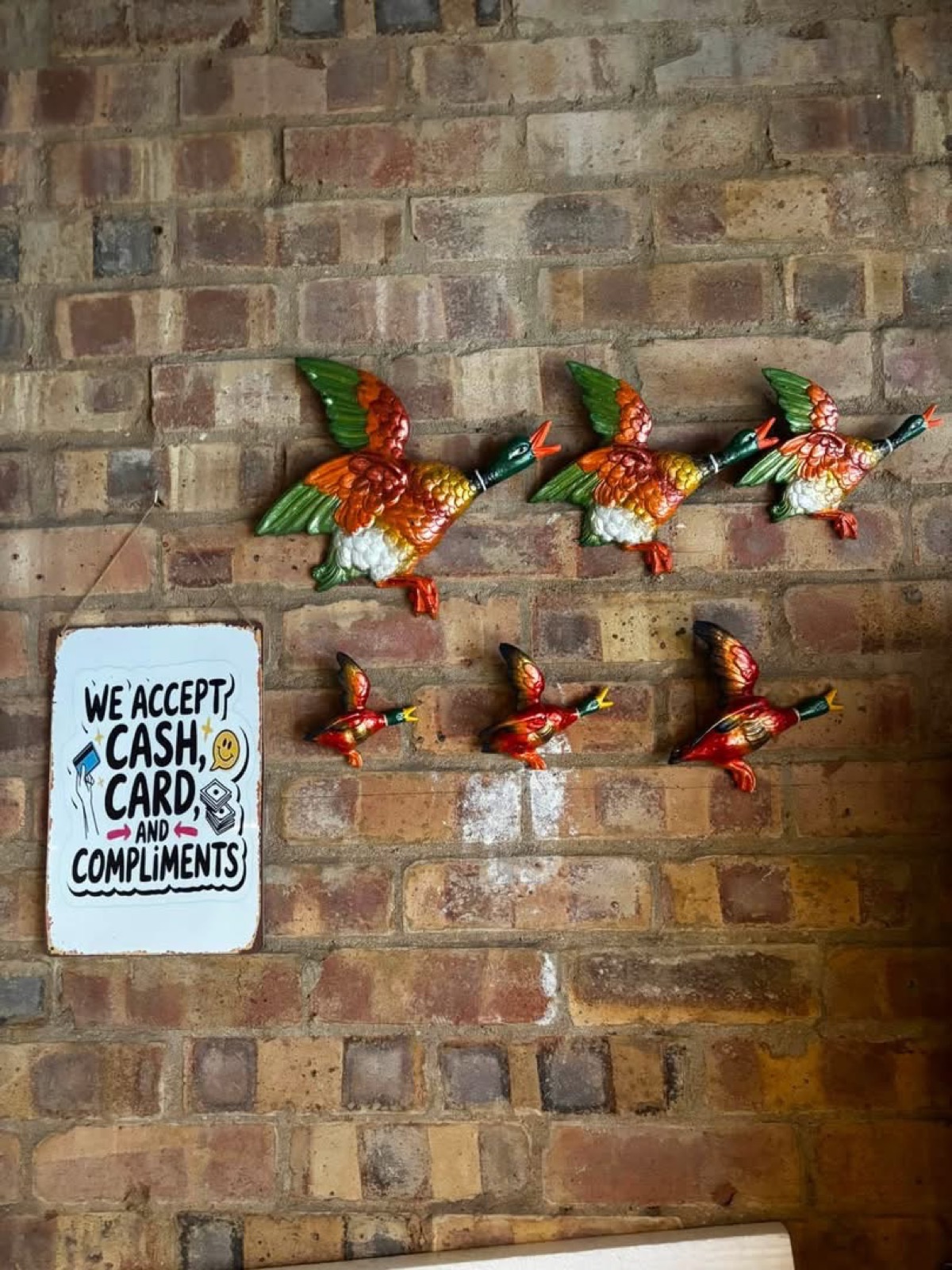
A large and small set on the wall
Where they came from
Flying duck wall plaques were already being sold as household ornaments in Britain by the 1930s, but they found their real audience over the following two decades, when a set of three climbing a chimney breast was simply an ordinary thing to own rather than a statement about anything at all.
The appeal was never complicated. They were affordable at a time when very little was, they filled the awkward stretch of wall above a fireplace, and a rising diagonal does something to a room that a framed picture hung square never manages, because it suggests movement in a space that hasn't got any.
By the 1960s that was beginning to fade, as tastes moved on and the ducks slowly turned into the kind of thing your parents had rather than the kind of thing you chose.
Who actually made them
The sets most people picture when they think of flying ducks came from Beswick in Stoke-on-Trent, who put them into production in 1938 and kept making them until 1973, thirty-five years of the same three birds.
They were sold in several sizes, and that is why old sets so often turn up mismatched today, because most families bought three but not always three that belonged together, and a few of the larger ones were made hollow at the back so you could stand something in them.
Plenty of other potteries made their own versions and some of them sold well, but it is that original shape people are still picturing when they talk about flying ducks today.
The bit everyone remembers
What brought them back into the national conversation was television, and one living room in particular.
In episode 1615 of Coronation Street, broadcast on 7 July 1976, Eddie Yeats sets about decorating the Ogdens' front room, runs out of wallpaper partway through, and covers the gap with a painted mountain scene that Hilda Ogden proudly calls her "muriel", a mispronunciation that outlived the mural.
The ducks arrived two years later, in 1978, flying across those painted mountains, and in the storyline they had come to Hilda from Elsie Tanner next door, who had kept flying ducks on her own wall earlier in the programme.
Two details about them are worth knowing, and the first is that they weren't ceramic at all: the television ducks were plaster of Paris, and fragile enough that the production kept having to replace them as they broke.
The second is that the middle duck hung crooked, nose down, and that was deliberate. Jean Alexander, who played Hilda, kept it askew as a running joke about the Ogdens' luck. Hilda would straighten it whenever she noticed, and it never stayed straight.
How they became a punchline
That is when the ducks stopped being furniture and became shorthand. Once a whole country recognises three birds on a wall as belonging to a particular sort of front room, they are a signal rather than decoration, and for about twenty years it was not a flattering one.
They became the thing comedians pointed at when they wanted a laugh about taste, so a lot of them ended up in skips, and charity shops filled with sets nobody wanted.
Hilda's own came down on screen in 1987, taken off the wall by her in her final scenes, and the production gave her the actual ducks as a leaving present before they were eventually sold at auction in 1999.
Why they came back
Enough time passed that the joke stopped working, and what is left once the mockery wears off is a good-looking object.
The diagonal still works, the birds are still well modelled, and a set that says something about where you grew up earns its place on a wall more easily than something chosen to match the sofa.
People go looking for the old ones again, and they mostly arrive broken, because neither plaster nor early ceramic survives being posted particularly well, and because a lot of them spent a decade in a loft first.
Which is where mine come in
I make mine in Leigh-on-Sea. I studied the old shapes closely enough to model my own, and mixed the colours back up by hand until they sat right.
I tried plaster of Paris first, the same material the television ducks were made from, and ran straight into the same problem the production had, because it breaks. After that came casting powder, then a pouring compound, and finally resin, which is the reason the sets I post today arrive in one piece rather than in several.
They are new, made by hand, and worked in the traditional style rather than copied from it, because I make my own moulds and paint every bird myself.