
A short history
Why people hang three flying ducks on the wall
There is no secret meaning, whatever the internet tells you. There is a practical reason, and it explains why the sets look the way they do.
 By Retha Lubbe
Maker, Upon The Clouds
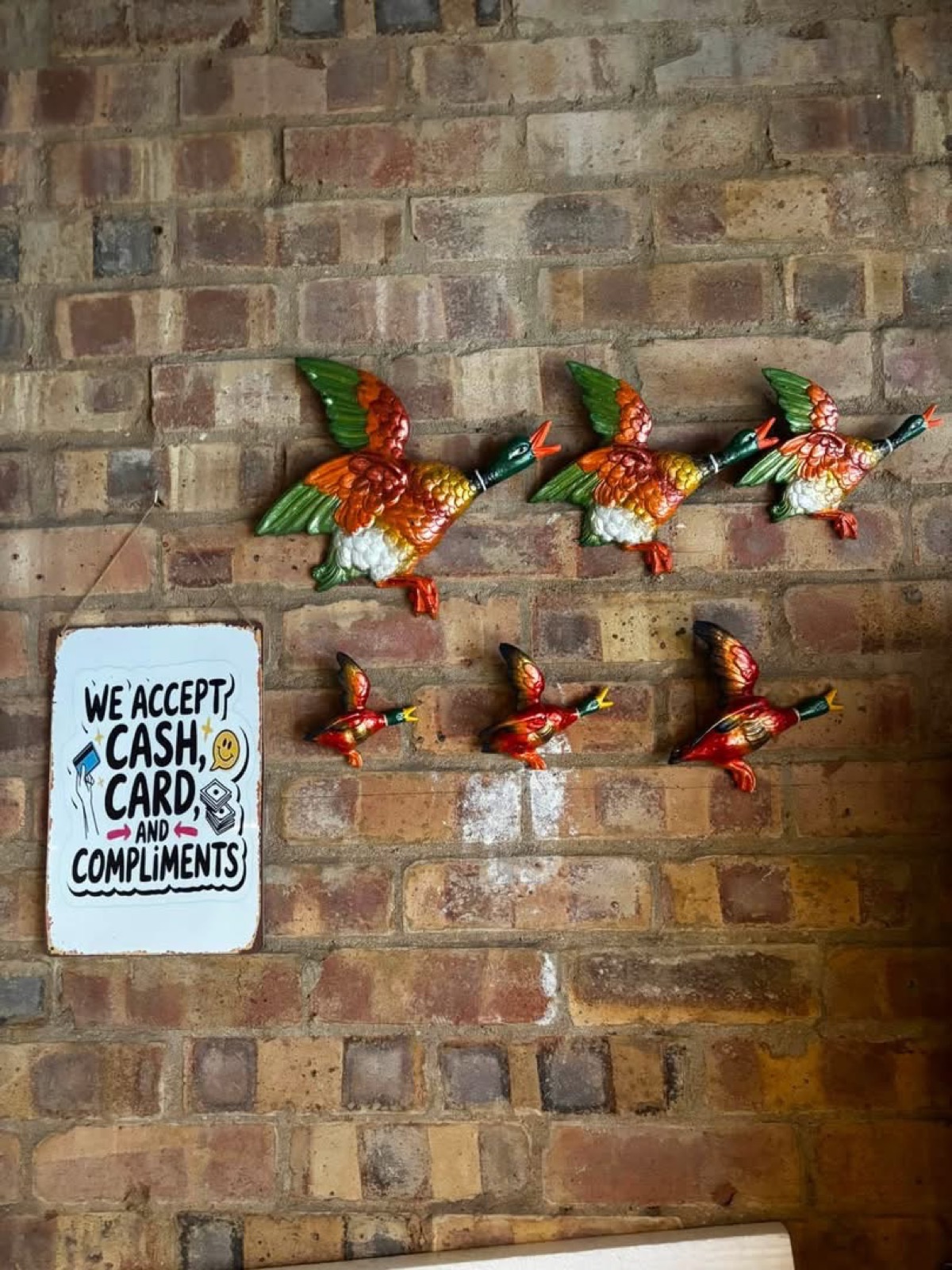
A large and small set on the wall
The short answer
People hang three flying ducks on the wall because three of them, made in graduating sizes and hung on a rising diagonal, do something no single ornament can manage on its own, which is to put movement into a room that hasn't got any.
You will find pages online offering you spiritual meanings and superstitions about luck or prosperity, and none of it holds up to any scrutiny, because the ducks were a mass-produced piece of affordable decoration rather than a folk tradition carrying anything with it.
Why they get smaller
The graduating sizes are doing something specific: the smallest bird reads as the furthest away, so a flat wall picks up a sense of depth that isn't really there, and the eye follows the three of them off towards the corner of the room as though they are heading somewhere.
Hang three the same size and the whole effect collapses into a row of ornaments. Hang them graduated and they read as a flight.
This is also why mismatched old sets look subtly wrong even to people who cannot say why. The originals were sold in several sizes and families didn't always buy three that belonged together, so a lot of the sets still on walls today are two from one size and one from another, and the illusion never quite lands.
Why three, and not two or four
Three is the number almost everything in a room gets arranged in, because odd groupings hold together as one object in a way that even ones do not, and a pair tends to read as symmetrical and static while four starts to look like a collection you are meant to count.
Three is also the smallest number that establishes a direction. Two birds sit next to each other. A third makes a line, and a line going upward reads as flight.
Where they actually go
The traditional spot is the chimney breast, climbing diagonally from the mantelpiece towards the ceiling, and that is where most people picture them because that is where a whole generation of them hung.
They work at least as well going up a staircase wall, following the line of the stairs, where the diagonal follows the stairs. A hallway does the same job. Above a bed is a quieter option that suits the smaller sets.
What they don't like is being hung level, or being centred over something in a way that makes them symmetrical, because the entire point is the diagonal and a straight line removes the movement.
Why people are hanging them again
For about twenty years they were shorthand for a particular sort of taste, and owning them put you on the wrong side of a joke. Television had more to do with that than the ducks did.
The joke has since worn off, and what is left is an object that was always well designed: the modelling is good, the diagonal still works, and a set on the wall says something about where somebody grew up rather than which shop they walked into last weekend.
Old sets are hunted for now, and they mostly arrive broken, because the early ones were plaster or ceramic and neither survives the post especially well.
If you want a set that arrives intact
I cast mine in resin and paint every bird by hand in Leigh-on-Sea, which is the reason they turn up in one piece rather than in several, and I make them in graduating sizes because anything else isn't really a set.